



Can a Fragrance Really Boost Your Mood
Walk through a department store today and you'll see fragrances promising confidence, happiness, focus, energy, calm, and even better sleep.
The fragrance industry has discovered something scientists have known for years: scent has a remarkable ability to influence how we feel.
But as more brands begin making mood-related claims, an important question emerges:
Can a fragrance really boost your mood, or are we simply being sold another wellness story?
Recent research suggests the answer is more nuanced—and more fascinating—than most marketing campaigns would have you believe.
Your Brain Is Smelling More Than You Think
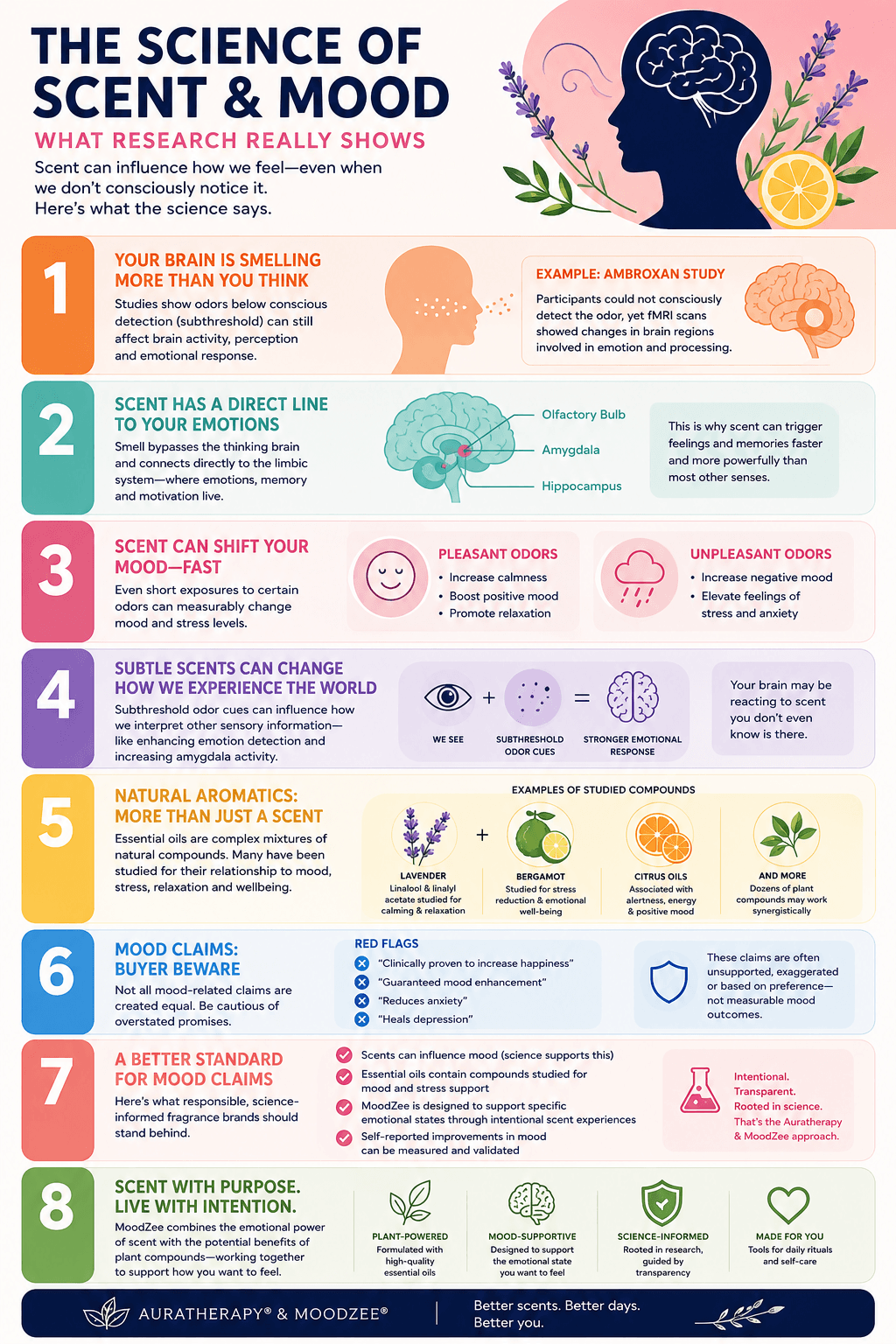
A recent article published by Perfumer & Flavorist highlighted growing research around what scientists call "subthreshold odors"—aromatic compounds present at levels too low for conscious detection.
In other words, your brain may be responding to scent even when you don't realize you're smelling anything.
Researchers have found that certain odor molecules can alter brain activity, emotional processing, and perception without participants being consciously aware of the scent itself.
This challenges a long-held assumption that if we can't smell something, it can't affect us.
The reality appears to be that our olfactory system is constantly gathering information from the environment, influencing our emotional experience in ways we may never consciously notice.
Why Scent Is Different From Our Other Senses
Unlike sight, hearing, or touch, smell has a uniquely direct connection to the brain's emotional centers.
Odor signals travel through pathways closely linked to the amygdala and other regions involved in memory, emotion, and emotional learning.
This may explain why a familiar scent can instantly transport us back to childhood, trigger feelings of comfort, or shift our emotional state before we've had time to think about it.
Researchers consistently find that scent can influence:
-
Mood
-
Emotional perception
-
Stress levels
-
Memory recall
-
Feelings of calmness or alertness
This is why hotels scent their lobbies, retailers scent their stores, and wellness brands increasingly use fragrance as part of a larger sensory experience.
The Part Most Fragrance Marketing Leaves Out
The latest research contains an important caveat.
Just because a scent influences mood doesn't mean every mood claim is automatically true.
Many modern fragrances contain aroma molecules that can affect perception and emotional response. Some of the research highlighted in recent publications uses synthetic aroma compounds as examples.
In other words, the brain responds to molecules—not marketing claims.
A pleasant scent may improve how someone feels. An unpleasant scent may create discomfort. The relationship between scent and mood is real.
But that doesn't mean a fragrance can treat anxiety, create happiness on demand, or guarantee confidence.
Consumers should be cautious whenever they see dramatic emotional promises attached to a perfume bottle.
Where Natural Aromatics May Be Different
This is where the conversation becomes particularly interesting.
Most traditional fragrances are designed primarily around scent performance, projection, and longevity.
Essential oils, on the other hand, are complex botanical extracts containing dozens—and sometimes hundreds—of naturally occurring aromatic compounds.
Many of these compounds have been studied independently for their relationship to mood, stress, relaxation, and emotional wellbeing.
For example:
-
Lavender contains linalool and linalyl acetate, compounds studied for their calming properties.
-
Bergamot has been investigated for its relationship to stress reduction and emotional wellbeing.
-
Citrus oils have been associated with increased alertness and positive mood in certain studies.
Scientists continue to explore whether these naturally occurring compounds contribute benefits beyond their aroma alone.
While more research is needed, this distinction highlights an important difference between fragrance designed purely to smell good and botanical aromatics traditionally used to support wellbeing.
A Better Way to Think About Mood and Scent
Perhaps the most responsible conclusion is this:
Scent is not medicine.
But scent is also far more powerful than most people realize.
Research increasingly supports the idea that aroma can influence our emotional experience, shape perception, evoke memories, and contribute to how we feel throughout the day.
At Auratherapy and Moodzee, we believe scent should be viewed as a tool for intentional self-care.
Not because fragrance can magically transform your life.
But because the simple act of breathing in an aroma designed to support calm, focus, joy, or energy can become a meaningful ritual—one that encourages us to pause, reconnect, and become more aware of how we're feeling.
The emerging science of scent reminds us that what we breathe matters.
And sometimes, the most powerful influences are the ones we don't consciously notice at all.
About The Author
Laura McCann is the Founder and CEO of Auratherapy and MoodZee, wellness fragrance brands dedicated to helping people transform how they feel through the power of scent, breath, and intention.
After experiencing a significant health crisis brought on by years of stress and burnout, Laura began exploring the connection between aromatherapy, emotional wellbeing, and the body's energy systems. Her personal healing journey inspired her to create Auratherapy, a category-defining brand that blends essential oil-based fragrances with chakra balancing, aura readings, and wellness rituals designed to support mind, body, and emotional health.
Today, Laura is a leading advocate for what she calls "breathable scent"—fragrances made with natural essential oils that go beyond smelling good to support intentional self-care practices. She is also the author of Auratherapy: A Guide to Adoring Yourself, Your Chakras, and Your Aura, where she explores the relationship between scent, energy, emotion, and personal transformation.
Through Auratherapy and Moodzee, Laura is helping redefine fragrance as a wellness tool—one that sits at the intersection of ancient wisdom, modern neuroscience, and the growing science of mood and scent.